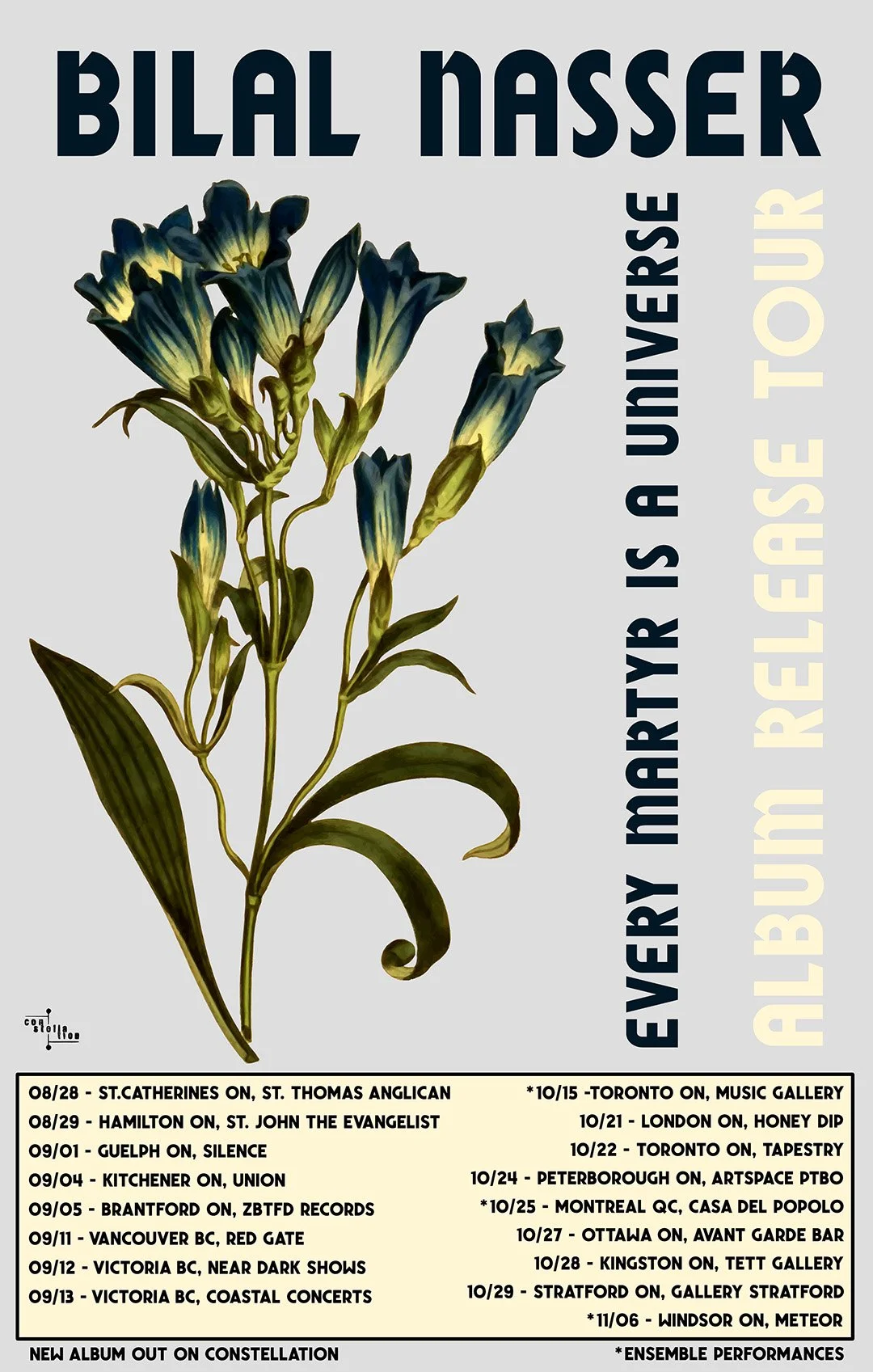
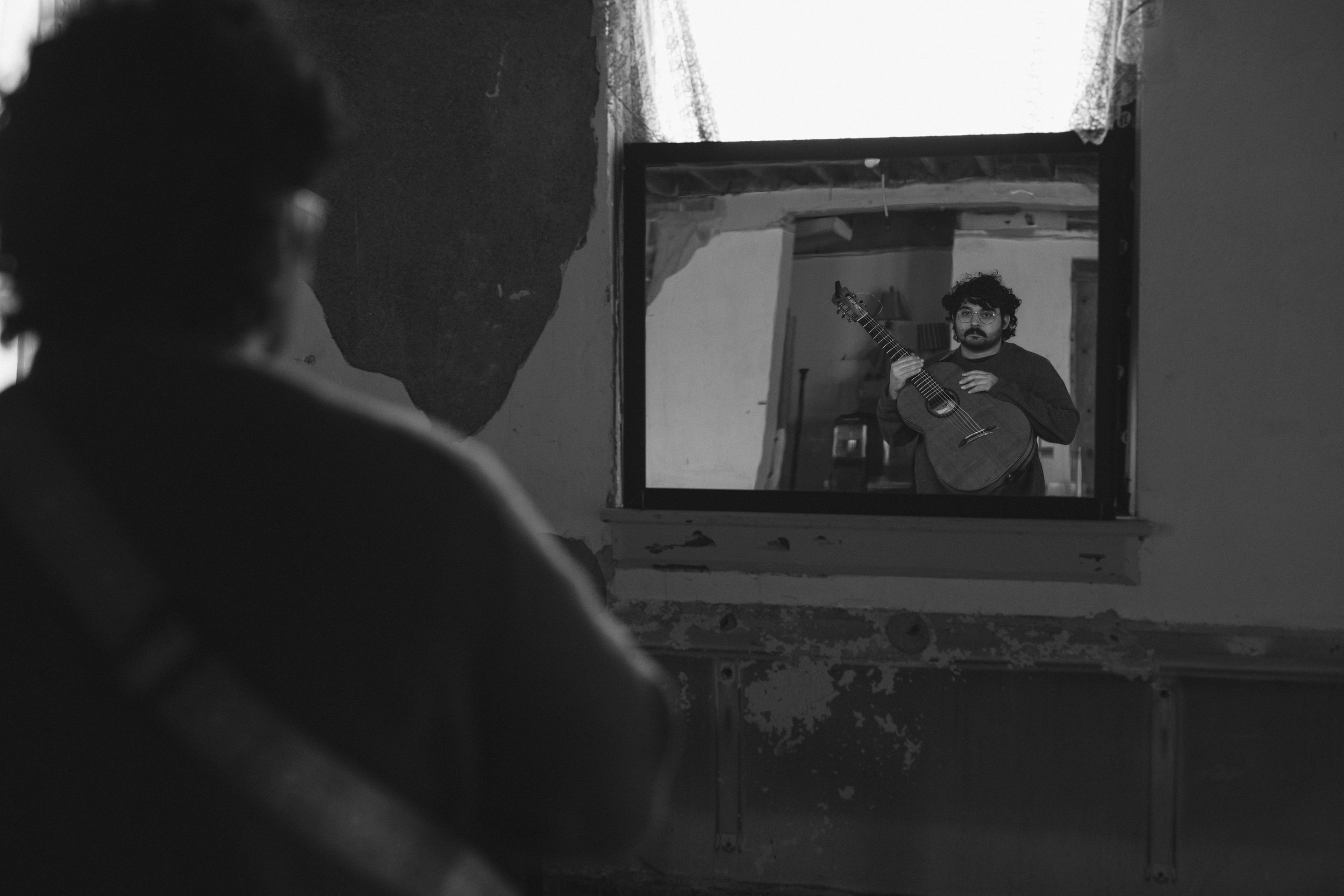
Bilal Nasser is a Palestinian-Canadian guitarist, composer, activist, and harm reduction worker from Windsor On. Raised in a family of primarily Palestinian refugees, he has been a participant in the Palestinian solidarity movement since childhood. His political and musical upbringings developed in tandem through his discovery of punk rock around the time of the 2008 Gaza wars and the later Arab spring uprisings. To Nasser, there is no separation between art and politics, while at the same time he maintains that art itself is not resistance itself devoid of collective political action.
Bilal was trained as a classical guitarist from a young age, and went on to win awards in composition and performance. While his technique is informed by his classical guitar background, Nasser’s music occurs as a frenetic juxtaposition of musical influences mainly rooted in a DIY ethos, namely in post-rock, shoegaze, hardcore, and drone. Nasser is deliberate through his immersion in underground musical cultures existing outside the boundaries established by the classical music world. Through his work, Nasser actively rejects the sterility and rigidity of institutional convention, bridging seemingly antithetical genres to cultivate new capacities for candid innovation- consequently realizing a distinct musical voice, coloured by his liminal exploration of both canonical and underground realms.
His use of electronics, effects pedals, home-made skateboard drone machines, tape loops and singing and screaming into his amplified guitar firmly situate his practice outside of the tradition of solo-guitar performance. He is the first known classical guitarist to have a mosh-pit at a concert. His performances often take place in unconventional settings like skateparks, dive bars, book stores, and warehouses. This is as much a class-conscious as an aesthetic choice, situating his practice in community while prioritizing access over formality.
In 2021 Nasser set a new precedent for classical composition with the release of his first full-length solo album Where the Orange Groves Grow, consisting of works for solo classical guitar, voice, and electronics. Orange Groves traverses a broad aesthetic range from sprawling, long-form solo guitar pieces depicting tales from the Palestinian diaspora of loss and memory, to frenzies of looped noise and violence.
In 2023 Bilal recorded his sophomore record, How Can We Say Nothing. Written and recorded before the ongoing genocide of Gaza and south Lebanon by the zionsist entity in 2023, it was not meant to be an overtly political project. The title, How Can We Say Nothing, was a personal rather than a political statement, which was accompanied by a photo of his late grandparents in Mecca as the cover. Upon it’s release in 2024, the album took a new meaning as an urgent outcry for mobilization- asking audiences to interrogate their own inaction in a time of forever wars and genocide.
Nasser toured extensively across Canada in support of How Can We Say Nothing, playing alongside acts including OBMIGIIZI, Atsuko Chiba, Horse Jumper of Love, Efrim Menuck, and One Leg One Eye, and at festivals including River and Sky, and Intersection. His work has been featured in Musicworks, Dominionated, CBC, NPR, and on Bell Fibe.
Nasser’s practice interrogates the inherent contradictions within the diaspora experience. He grapples with what he views as the inescapable hypocrisy of making political art from the imperial core, while those on the front lines of what Mohammed Abdou describes as the “end-times wars” engage in direct resistance. Whether “resistance art” is futile in a time of genocide is still a tension that remains ever-present in Nasser’s work. At the same time, he recognizes the utility of art as a communal, spiritual, and organizational tool towards ends of liberation as embodied by Ghassan Kanafani, Marcel Khalife, and Mohammed El Kurd.